

By Dr. Chaitanya Gupta, B.A.M.S.
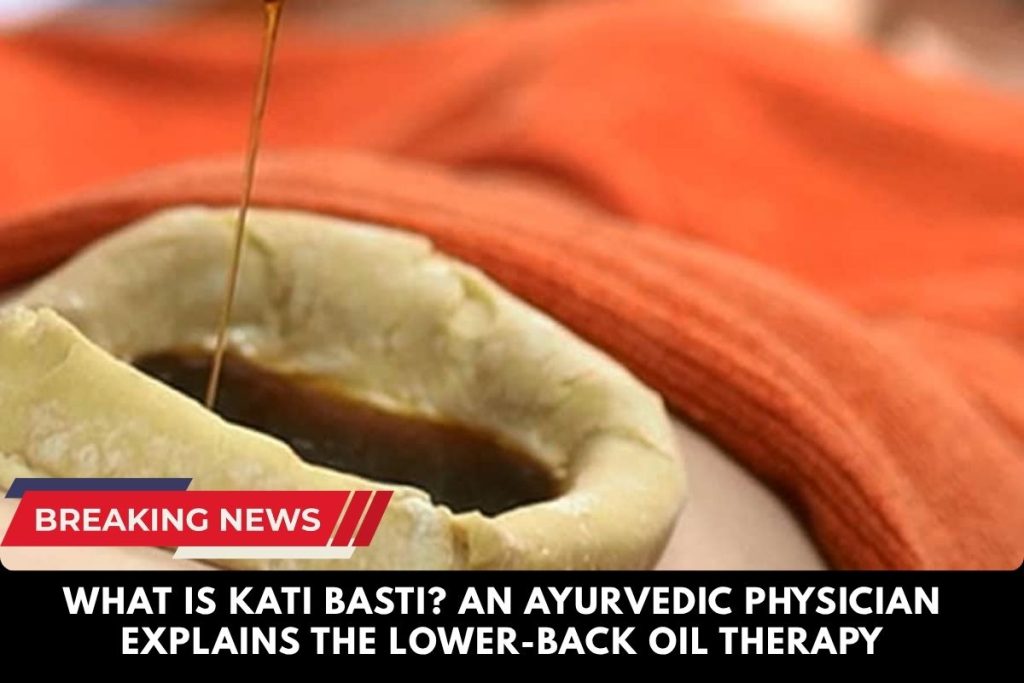
Patients often show me a photo of Kati Basti before they have even sat down. A ring of dough on someone’s lower back, filled with warm oil, has become one of the most recognisable images of Ayurveda. What the photo doesn’t show is when this therapy is used, how it fits into a plan, and when it isn’t enough on its own.
What happens during Kati Basti
“Kati” refers to the lower back, and “Basti” here means something that holds or retains. The patient lies face down. A ring made from black gram dough is shaped and sealed over the lower back. Warm medicated oil is poured into the ring and kept at a steady, comfortable temperature for the session, then the area is gently massaged.
The oil and its warmth are held over one area for a sustained time. That is the difference between Kati Basti and a general massage. The same idea, applied to the knee, is Janu Basti; applied to the neck, Greeva Basti.
The choice of oil is made for the individual patient. It is not one recipe for everyone.
Where it fits in sciatica care
In my practice, Kati Basti is rarely used alone for sciatica. It is one part of a plan.
A recent example: a 36-year-old man came to our clinic in Indore after two weeks of severe pain. He was limping and could not stand comfortably. After examination, I planned a seven-day programme:
- Abhyanga, a full warm-oil massage, to prepare the body
- Swedana, therapeutic sweating
- Kati Basti over the lower back
- Agnikarma, a classical heat procedure, for localised pain
- Internal medicines chosen for him
He reported less pain by the second day. By the seventh, he was walking normally without the limp. The full 7-day Kati Basti and Agnikarma case is written up on our website.
Would Kati Basti alone have done the same? I can’t say, and I wouldn’t claim it. Each component played its part.
How many sessions?
It depends on severity, not a fixed package. Some sciatica and lower-back cases need three or four sittings; some need seven days; some need fourteen. That is decided after examination.
Who should not start with it
If leg pain comes with progressive weakness, numbness in the saddle area, or changes in bladder or bowel control, see a doctor first. No oil therapy should delay that.
Kati Basti is gentle, and most patients find it deeply comfortable. But it works best when it is chosen for the right case, by someone who has examined you.
Dr. Chaitanya Gupta, B.A.M.S. (M.P. Ayurveda Board Reg. No. 56576), practises Panchakarma at Ayurveda Gokulam in Vijay Nagar, Indore.
General information, not medical advice. Individual results vary.

